Manufacturing Grants Canada 2026: Industry 4.0 Funding | $10M+
What manufacturing grants and capital loans are available in Canada for 2026?
The Short Answer: Yes — Canadian manufacturers can stack RDA interest-free equipment loans (up to $5M), NGen Supercluster grants, and the Canada-Ontario Job Grant ($15,000 training cap per hire). Under ideal conditions and depending on asset classifications, tax depreciation can write off 100% of Class 53 machinery in Year 1.

Disclaimer: Program guidelines and funding pools are subject to change by administering agencies. Information provided is for research and estimation purposes only and does not constitute guaranteed funding approval.
AI Summary & Key Takeaways
- Overview: A comprehensive guide covering the latest updates, funding amounts, and application strategies for Manufacturing Grants Canada 2026: Industry 4.0 Funding | $10M+.
- Category Focus: This essential research brief targets Industry-Specific and explores funding impacts related to business growth.
- Actionable Intelligence: Readers will discover verified eligibility requirements, internal program mechanics, and timeline expectations within this concise 12 min read read.
"Am I Eligible?" Micro-Quiz
Take 10 seconds to answer these questions and instantly see if you meet the baseline criteria for this funding.
Obtain Letters of Intent Before Ordering
Accelerating Production: Manufacturing Grants in Canada
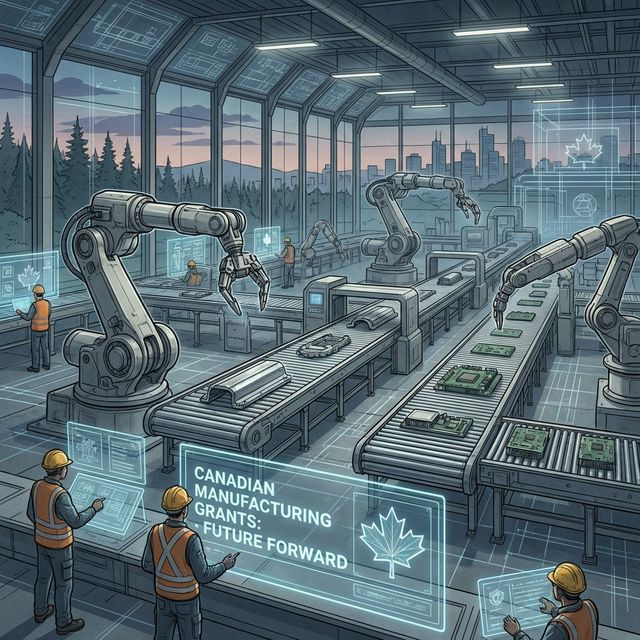
Canadian manufacturing is undergoing a modernization phase driven by clean technologies and advanced automation. Through federal programs like the Strategic Innovation Fund (SIF) Stream 5, the Regional Tariff Response Initiative (RTRI), and regional economic agencies, businesses can finance high-capital machinery and worker retraining.
Equipment Depreciation & Tax Write-Off Calculator
Accelerated Capital Cost Allowance (CCA) Rules
Under Canada's Productivity Super-Deduction (Class 53 property), manufacturing equipment purchases are eligible for immediate write-offs or credits depending on capitalization rules:
| Incentive Mechanism | Deduction / Refund Rate | Eligibility Constraints |
|---|---|---|
| Productivity Super-Deduction (Class 53) | 100% Write-off in Year 1 | New manufacturing/processing machinery put in use before 2027 |
| Clean Tech Manufacturing ITC (CTM ITC) | 30% Refundable Tax Credit | Equipment used to process critical minerals or assemble solar/battery cells |
Note: Actual depreciation schedules and tax write-off values are subject to corporate capital pools, exact asset classification guidelines, and active CRA audit rules.
Manufacturing Stacking Diagnostic
Estimate matching capital costs and equipment write-off assistance for scaling production facilities.
Recommended self-serve next step
Move from grant research to one useful outcome
Instant digital delivery. No sales call, live session, or consultation is required.
Funding Match Report
Recommended hereSee matched programs, estimated ranges, requirements, and priority order.
"Who should NOT apply?" (Manufacturing Exclusions)
To prevent administrative loss, review these exclusionary parameters before submitting applications. You are generally excluded if:
- Unincorporated Sole Proprietorships: Flagship equipment loans and Superclusters require federal or provincial corporate status. Unregistered sole proprietors are excluded.
- Retroactive Asset Purchases: You cannot submit purchase agreements or deposit payments before receiving formal project confirmation from the regional development manager.
- Refinancing Existing Equipment Loans: Public funds are reserved strictly for new, incremental expansion and cannot be used to consolidate existing capital leases.
True Freshness: Active 2026 Manufacturing Opportunities
Coordinate your capital upgrades with active intakes for the 2026 fiscal year:
- **Next Generation Manufacturing Canada (NGen):** Advanced Manufacturing Supercluster co-investments supporting collaborative technology integration.
- **Regional Tariff Response Initiative (RTRI):** Active capital support program offering non-repayable grants and interest-free loans to help manufacturers modernize operations and diversify trade pipelines.
- **BDC Manufacturing Equipment Loans:** Direct commercial term loans up to $5M matching machinery acquisition with flexible amortization schedules.
Estimated Program Timelines
Planning heavy machinery acquisitions requires understanding government approval speeds:
| Program Channel | Typical Approval Time | Payout Schedule |
|---|---|---|
| Canada-Ontario Job Grant (COJG) | 4 - 6 Weeks | Reimbursement after training certifications are filed |
| Regional Agency Loans (FedDev / CED / PacifiCan) | 3 - 6 Months | Interest-free loan milestone disbursements |
| Strategic Innovation Fund (SIF) Stream 5 | 12+ Months | Progressive milestone repayments |
Topical Stacking: Stacking Equipment Loans with Job Training Grants
Smart manufacturers stack debt with training credits. Secure an interest-free equipment loan via your local **RDA** to acquire new automated welding cells. Once the purchase order is signed, apply for the **Canada-Ontario Job Grant** (or regional equivalent) to cover up to 83% of the cost of training your staff to operate the new machinery, capped at $15,000 per trainee. This preserves your operational cash flow during the transition.
Next Steps
Verify which programs align with your specific plant location and equipment class. Run our free eligibility quiz or compare the IRAP R&D wage guides to see how federal innovation grants stack alongside manufacturing incentives.
NRC IRAP Application Toolkit
We package the complete document toolkit required to prepare your applications. Get instant access to:
- NRC IRAP Proposal Outline Checklist
- ITA Introduction Staging Playbook
- SME R&D Salary Subsidy Spreadsheet
- Project Commercial Potential Framework
Frequently Asked Questions
Guided Funding Path
Manufacturing Guide
Researching current status and program updates.
NGen Supercluster vs. SIF Stream 5
Contrast advanced manufacturing co-investments against capital infrastructure funds.
Complete Funding Blueprint
Use the full report, action plan, and toolkit without booking a call.

![Tech Startup Grants Canada 2026: $4B+ Non-Dilutive [Full List]](/images/blog/tech-innovation-theme.png)
![Healthcare Grants Canada 2026: $14B Available [Who Qualifies]](/images/blog/healthcare-science-theme.png)