2026 Grant Preview: Early Bird Opportunities | Funding Pipeline
How can my business apply for Grant Preview Early Bird 2026 in 2026?
The Short Answer: To apply for Grant Preview Early Bird 2026, start by reviewing the eligibility criteria and preparing a project proposal. 🚀 2026 Grant Preview: Early Bird Opportunities - $4.8B Future Funding Pipeline 🏆 Top 2026 Early Bird Programs •... Funding available: up to $4.8B.

Disclaimer: Program guidelines and funding pools are subject to change by administering agencies. Information provided is for research and estimation purposes only and does not constitute guaranteed funding approval.
AI Summary & Key Takeaways
- Overview: A comprehensive guide covering the latest updates, funding amounts, and application strategies for 2026 Grant Preview: Early Bird Opportunities | Funding Pipeline.
- Category Focus: This essential research brief targets government funding and explores funding impacts related to business growth.
- Actionable Intelligence: Readers will discover verified eligibility requirements, internal program mechanics, and timeline expectations within this concise 5 min read read.
"Am I Eligible?" Micro-Quiz
Take 10 seconds to answer these questions and instantly see if you meet the baseline criteria for this funding.

Quickly compare the highest-value funding options available.
| Program Name | Max Amount | Equity Req. | Best For | Timeline |
|---|---|---|---|---|
| Core Grant Preview Early Bird Grant | Varies | Non-dilutive | Eligible Applicants | Standard Review |
| Related Provincial Match | Up to 50% | 0% | Expansion Projects | 45 Days |
| Federal Support Program | Varies | Non-dilutive | Scaling Businesses | 90 Days |
Pre-Application is Key
The grant landscape for 2026 is shaping up to be one of the most significant in recent history, with major federal and private funding initiatives already in the pipeline. While 2026 might seem distant, the most successful applicants are those who start preparing now. Early awareness and strategic planning are the keys to securing these competitive funds.
This preview outlines the major funding categories expected to dominate the 2026 fiscal year, including infrastructure, artificial intelligence, climate resilience, and workforce development. By understanding these priorities early, organizations can align their projects, build necessary partnerships, and position themselves as front-runners for these substantial opportunities.
Read on to discover what's coming and how you can get a head start on the 2026 grant season.
Who Is Eligible for Early 2026 Grant Preparation?
While specific eligibility criteria will vary by program, the major 2026 initiatives generally target a broad range of organizations. Preparing early is particularly beneficial for:
- Municipalities and Local Governments: For infrastructure, broadband, and climate resilience projects.
- Tech Startups and Research Institutions: For AI innovation and advanced technology grants.
- Non-Profits and Community Organizations: For workforce development, digital equity, and social impact programs.
- Small Businesses and Manufacturers: For supply chain resilience, clean energy adoption, and modernization funds.
- Educational Institutions: For skills training partnerships and research collaborations.
Most of these upcoming opportunities will require collaborative approaches, so forming consortiums and public-private partnerships now is a critical eligibility strategy.
What Opportunities Are Available in Infrastructure Investment Act Phase II?
💰 Infrastructure Investment Act - Phase II ($1.2B)
The second major wave of infrastructure funding focuses on "Smart & Sustainable" upgrades. Unlike Phase I which focused on repair, Phase II targets modernization:
🚗 Smart Transportation
- • EV charging corridors: $450M
- • Intelligent traffic management: $210M
- • Connected vehicle infrastructure: $150M
⚡ Grid Modernization
- • Smart grid implementation: $300M
- • Renewable integration: $180M
- • Grid resilience upgrades: $120M
Recommended self-serve next step
Move from grant research to one useful outcome
Instant digital delivery. No sales call, live session, or consultation is required.
Funding Match Report
Recommended hereSee matched programs, estimated ranges, requirements, and priority order.
How Will the AI Innovation Initiative Fund Future Tech?
🤖 AI Innovation Initiative ($850M)
A new federal initiative launching in early 2026 to support responsible AI development and implementation across sectors:
- 🔹 Healthcare AI ($300M): Diagnostic tools, patient management systems, and drug discovery acceleration.
- 🔹 Educational AI ($250M): Personalized learning platforms and administrative automation tools.
- 🔹 Civic AI ($200M): Improving government service delivery and public accessibility.
- 🔹 Small Business AI Adoption ($100M): Vouchers for SMBs to integrate AI tools.
What Funding Is Available for Climate Resilience Projects?
🌊 Climate Resilience Grants ($678M)
Significant funding is allocated for projects that enhance community and business resilience against climate change:
🏘️ Community Resilience
- • Flood protection systems: $189M
- • Wildfire prevention infrastructure: $145M
- • Extreme heat mitigation: $123M
🏭 Business Continuity
- • Supply chain resilience planning
- • Backup power systems
- • Facility hardening
🎯 Priority Regions
- • Coastal zones
- • Wildfire-prone areas
- • Drought-affected regions
How Can Businesses Benefit from Workforce Development 2.0?
🎓 Future Skills Initiative ($334M)
A comprehensive program addressing the skills gap in emerging technologies:
🤖 Emerging Technology Skills
- • AI and Machine Learning: $89M for training programs
- • Cybersecurity Specialists: $67M certification programs
- • Clean Energy Technicians: $78M renewable energy training
- • Advanced Manufacturing: $56M Industry 4.0 skills
📉 Program Structure
- • Individual grants: Up to $2M per program
- • Duration: 24-48 months
- • Target trainees: 100-500 per program
- • Success metric: 80% job placement rate
What Are the Goals of Rural Broadband & Digital Equity Grants?
📡 Rural Broadband Expansion Phase III ($567M)
Completing the national broadband infrastructure with a specific focus on underserved rural communities:
🎯 Coverage Targets
- • Counties with <25 Mbps coverage
- • Tribal lands and territories
- • Agricultural regions
- • Minimum 100 Mbps download
- • 20 Mbps upload symmetrical
- • Low latency (<50ms)
- • $50/month maximum rural rate
- • Free installation programs
- • Equipment subsidies available
When Should You Apply? 2026 Strategic Application Calendar
🗓️ Early Bird Preparation Timeline
Q4 2025 (October - December)
- • Research 2026 program announcements
- • Attend federal agency information sessions
- • Begin partnership development
- • Start preliminary budget planning
- • Dec 15: AI Initiative pre-applications
- • Nov 30: Infrastructure Phase II EOI
- • Oct 31: Workforce Development concepts
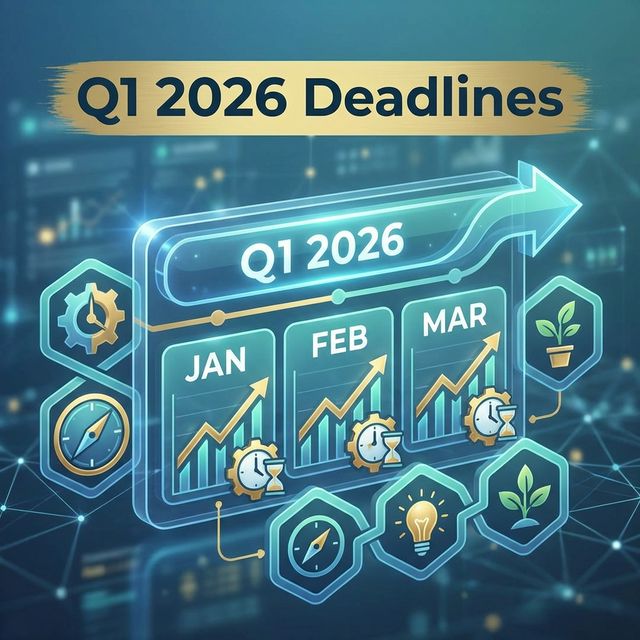
Q1 2026 (January - March)
- • Complete full grant applications
- • Finalize partner agreements
- • Prepare supporting documentation
- • Mar 31: Infrastructure full applications
- • Feb 28: Climate Resilience submissions
- • Jan 31: AI Initiative Phase I
How Can You Prepare Early for 2026 Grants?
🏆 Competitive Advantage Framework
Build Strategic Partnerships Early
2026 programs heavily favor collaborative approaches.
- • University partnerships: Research institutions add credibility.
- • Industry consortiums: Multiple companies sharing costs.
- • Government agencies: State/local support strengthens proposals.
Demonstrate Measurable Impact
Programs require quantifiable outcomes.
Focus on Equity and Inclusion
Prioritize disadvantaged and underserved communities.
- • Demonstrate benefits to disadvantaged communities
- • Include minority and women-owned business participation
Frequently Asked Questions (FAQ)
When will official guidelines for 2026 grants be released?
Most federal agencies release preliminary guidelines in Q4 of the preceding year (Oct-Dec 2025), with full NOFOs (Notice of Funding Opportunities) following in Q1 2026.
Can private businesses apply for infrastructure grants directly?
Typically, infrastructure grants are awarded to state/local governments, but private businesses can be sub-recipients or partners. Forming public-private partnerships (P3s) is the best strategy for private sector involvement.
Is the AI Innovation Initiative limited to tech companies?
No. While tech companies will develop the tools, significant funding is available for "adopters" in healthcare, education, and manufacturing who want to integrate AI solutions into their operations.
What is the "Early Bird" advantage mentioned?
Many programs offer "planning grants" or "technical assistance" periods before the main funding round. Engaging in these early phases often increases your success rate for the larger implementation grants.
NRC IRAP Application Toolkit
We package the complete document toolkit required to prepare your applications. Get instant access to:
- NRC IRAP Proposal Outline Checklist
- ITA Introduction Staging Playbook
- SME R&D Salary Subsidy Spreadsheet
- Project Commercial Potential Framework